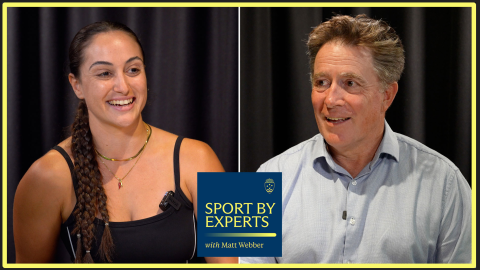
Dietitian Myria Cano-Hall joins Matt Webber on Bond University’s Sport by Experts podcast for a deep dive into some very troubling survey findings.
A few weeks ago, the ABC published findings from its Elite Athletes in Australian Women’s Sport Survey.
The national survey of 152 current and recently retired elite athletes across 47 sports revealed high rates of disordered eating, body dissatisfaction and menstrual irregularities.
Bond University-trained nutritionist Myria Cano-Hall said the data should prompt urgent change across coaching, medical and high-performance systems.
Speaking on Sport by Experts, Cano-Hall said the results confirmed what she sees daily in practice.
She warned that chronic under-fuelling, misinformation and body image pressure are quietly undermining the health and performance of elite females.
You wouldn’t drive a car with an empty tank
Cano-Hall identified low energy availability (LEA) - where athletes do not consume enough fuel to support their training - as the underlying driver of many health problems.
“Low energy availability is essentially the bottom line,” she said. “We see poor mood, low energy, digestive issues - a whole range of symptoms that all stem from under-fuelling.”
At its most severe, LEA progresses to Relative Energy Deficiency in Sport (RED-S), which affects hormones, bone density, muscle mass, recovery and long-term health.
“It impacts fertility, bone health, training adaptations - it’s just a multitude of things that you really don’t want going on,” Cano-Hall said.
She warned that while athletes may maintain performance temporarily, the consequences eventually surface.
“You can get away with it for a period of time,” she said. “But at some point your body — like an engine — is just going to blow up.”
The good and the bad of social media
Even Cano-Hall, whose own Instagram and TikTok content is a rich source of current, scientifically-backed nutrition advice, acknowledges a significant downside to social media becoming a dominant source of diet advice for athletes.
“Nowadays anybody can go on social media and say anything, even if they’re not qualified,” she said.
“Even as a sports dietitian, I find nutrition information on social media confusing.”
She said carbohydrates have been particularly demonised, leading many athletes to restrict a key performance fuel.
“Athletes are afraid that if they start eating more, it may change their body composition — even if they know it will benefit their health and performance,” she said.
She explained that weight fluctuations following increased carbohydrate intake are typically due to glycogen and water storage, not fat gain - a distinction often misunderstood.

The pitfalls of aspirational aesthetics
The survey found that more than 50 per cent of elite female athletes reported neutral or negative feelings about their body, a statistic Cano-Hall described as deeply troubling.
“It’s heartbreaking,” she said. “These athletes put in so much hard work, yet more than half are dissatisfied with what they see in the mirror.”
She said rigid expectations around how female athletes ‘should’ look ignore the physical diversity required across sports and positions.
“There’s this weird idea of what an athlete is meant to look like,” she said. “But a rugby player is not meant to look like a marathon runner. Athletes are built for their position, not an aesthetic ideal.”
Menstrual dysfunction is not normal
Cano-Hall said the prevalence of menstrual irregularities among elite female athletes was one of the most alarming findings.
“One of the main presentations that I see is athletes who either don’t have a menstrual cycle at all or have completely lost it. It’s very, very common in female athletes,” she said.
According to the survey, 75 per cent of elite female athletes have experienced menstrual irregularities, yet cycles are rarely considered when designing training programs.
“There’s still an odd normalisation around it,” Cano-Hall said. “If an athlete loses their cycle, it can be seen as, ‘Oh, they’re working hard enough’. That simply should not be.”
Long-term health consequences extend beyond sport
Cano-Hall warned that prolonged menstrual disruption can have lasting physiological consequences, particularly for bone health.
“When an athlete loses their cycle, their hormone profile is essentially the same as a post-menopausal woman,” she said. “That has massive implications for bone health.”
She said stress fractures and recurrent injuries are common outcomes, along with potential fertility issues later in life.
“Even if the cycle returns, that doesn’t always mean healthy ovulation returns,” she said.
She also raised concerns about the widespread use of hormonal contraception masking symptoms of RED-S, making diagnosis more difficult.
“It can act like a Band-Aid,” she said. “It protects bone health in some cases, but it can hide what’s really going on.”
Forearmed is forewarned
Cano-Hall said many athletes lack access to qualified sports dietitians due to financial constraints, despite nutrition being fundamental to performance and health.
“Athletes don’t earn a lot of money, and seeing a dietitian isn’t cheap,” she said.
She urged athletes to seek credible, evidence-based information and to rethink assumptions about fuelling.
“Athletes aren’t normal people in terms of energy needs,” Cano-Hall said. “They shouldn’t be eating like everyone else — they need to eat in line with how much they train.”
Her final message was simple.
“Be mindful of how big your fuel tank is,” she said. “It’s probably much bigger than you think.”
Myria Cano-Hall is an Accredited Practicing Dietician and the founder of Athelite Nutrition. You can follow her on Instagram here.
Myria completed a Bachelor of Health Sciences and a Masters of Nutrition and Dietetics at Bond University where she also teaches.
Sport By Experts is also available on Spotify and Apple Podcasts.