


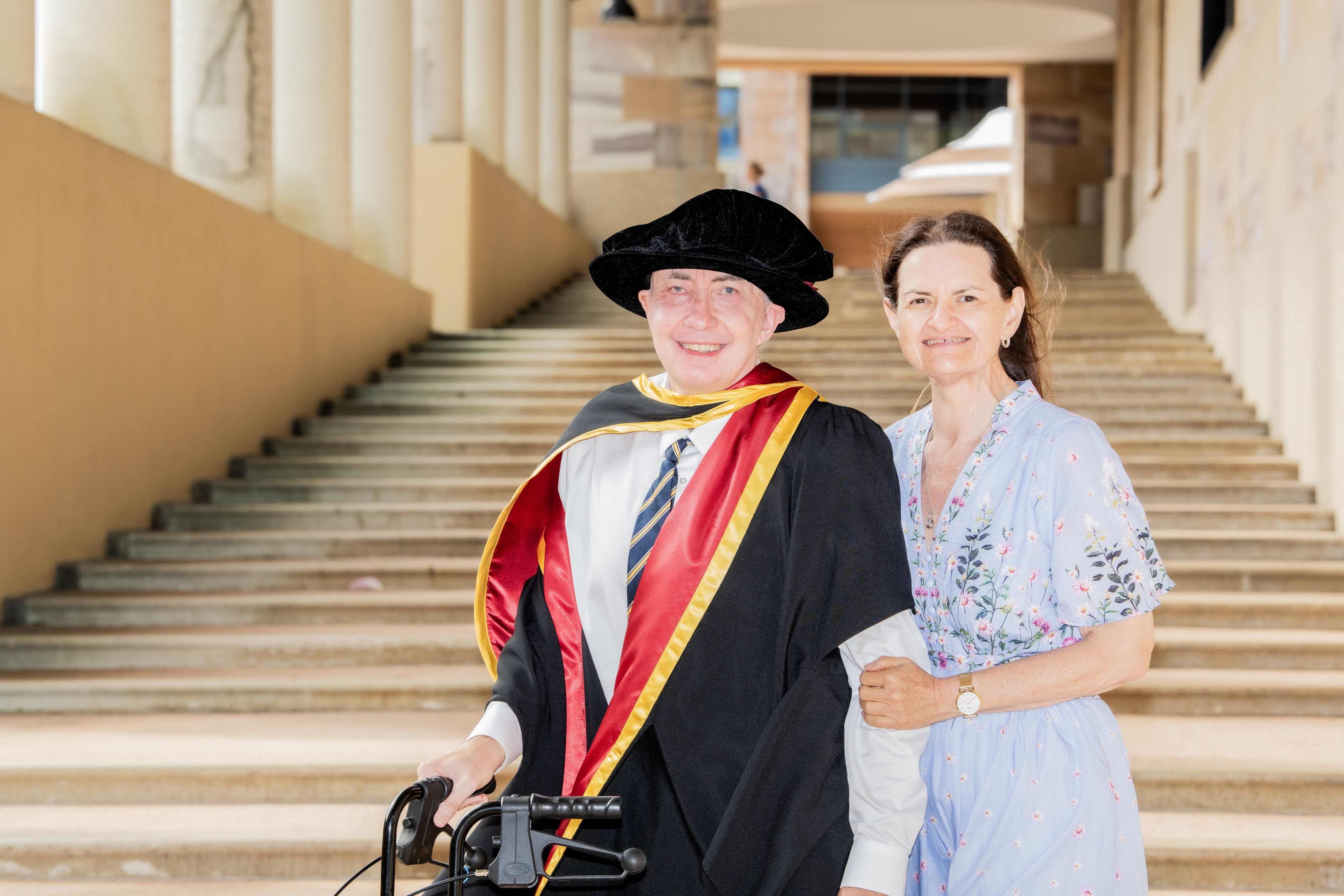
A sea of fellow Bondies watched Dr Andrew Harris walk across the December 2025 graduation stage to receive his Doctor of Philosophy (PhD) certificate. What they couldn’t see were the gruelling challenges he’d overcome to get there. From proving to doctors he could walk, to two decades spent empowering others in the disability and adult learning sector, to undergoing a kidney transplant as he began his thesis — Andrew’s story is one of determination.


Andrew’s PhD combined his two lifelong passions; English and criminology. Born with cerebral palsy, he could read before he could walk, and was fascinated by the psyche of murderers after notorious serial killer, the Yorkshire Ripper, terrorised Leeds and Bradford near his home town in the United Kingdom in the 1970s.
“At just seven, I remember my group of mates saying we were going to catch the Yorkshire Ripper when we grew up because the police weren’t doing very well at it,” Andrew says.
“My three older sisters were terrified, walking around day and night wondering if every man they saw was the killer.
“That seeped in to me and, later on, criminology really grabbed me.”
The Yorkshire Ripper, Peter Sutcliffe, killed 13 women before he was eventually arrested when Andrew was 11. Like many people who are drawn to true crime, he was curious to understand how a person could become a murderer, seemingly for no reason.
“In actual fact, it’s a convergence of a dozen different things that can go wrong — and that's the basis of my PhD,” he says.
‘Write what you know’
Andrew’s PhD comprised three components — a thesis titled 'Crafting a Crime Novel Informed by the Scholarly Literature on Multiple Murder’; a research study in which he interviewed psychologists and criminologists; and a fiction book incorporating his learnings.
The novel titled Lay Down with the Devil follows the life of a serial killer, flashing back to the traumatic events that shaped him. While it draws on the theory and findings from Andrew’s PhD, it was written for a general audience, touching on pop culture and the social movements of the 1970s.
“Through my research, I found offenders often lacked power or control in their lives,” Andrew says.
“The main character doesn’t identify with the changes happening around him and doesn’t fit in. His crimes are a means for him to feel better.”
Andrew's primary supervisor, Assistant Professor of Criminology Dr Gaelle Brotto, says the novel is authentic and doesn't fall into the myths and tropes that crime writers often embrace.
"I honestly could not put it down. It is anchored in the criminology literature and supported by experts in the field," she says.
Walkley Award-winning journalist and Associate Professor in the Faculty of Society & Design Dr Caroline Graham was another supervsior. She says the novel is a wonderful example of marrying deep academic research with creative flair and a passion for storytelling.
“Andrew’s novel is a gritty, suspenseful journey into the dark mind of a criminal that resists so many of the tropes of crime fiction and instead finds a much more honest, grounded way to tell the story,” she says.
Andrew drew inspiration from real cases, as well as traumatic events from his own life.
“To some extent, you have to write what you know,” he says.
“You might not pinpoint where, but some events are exaggerations of my own experiences.”

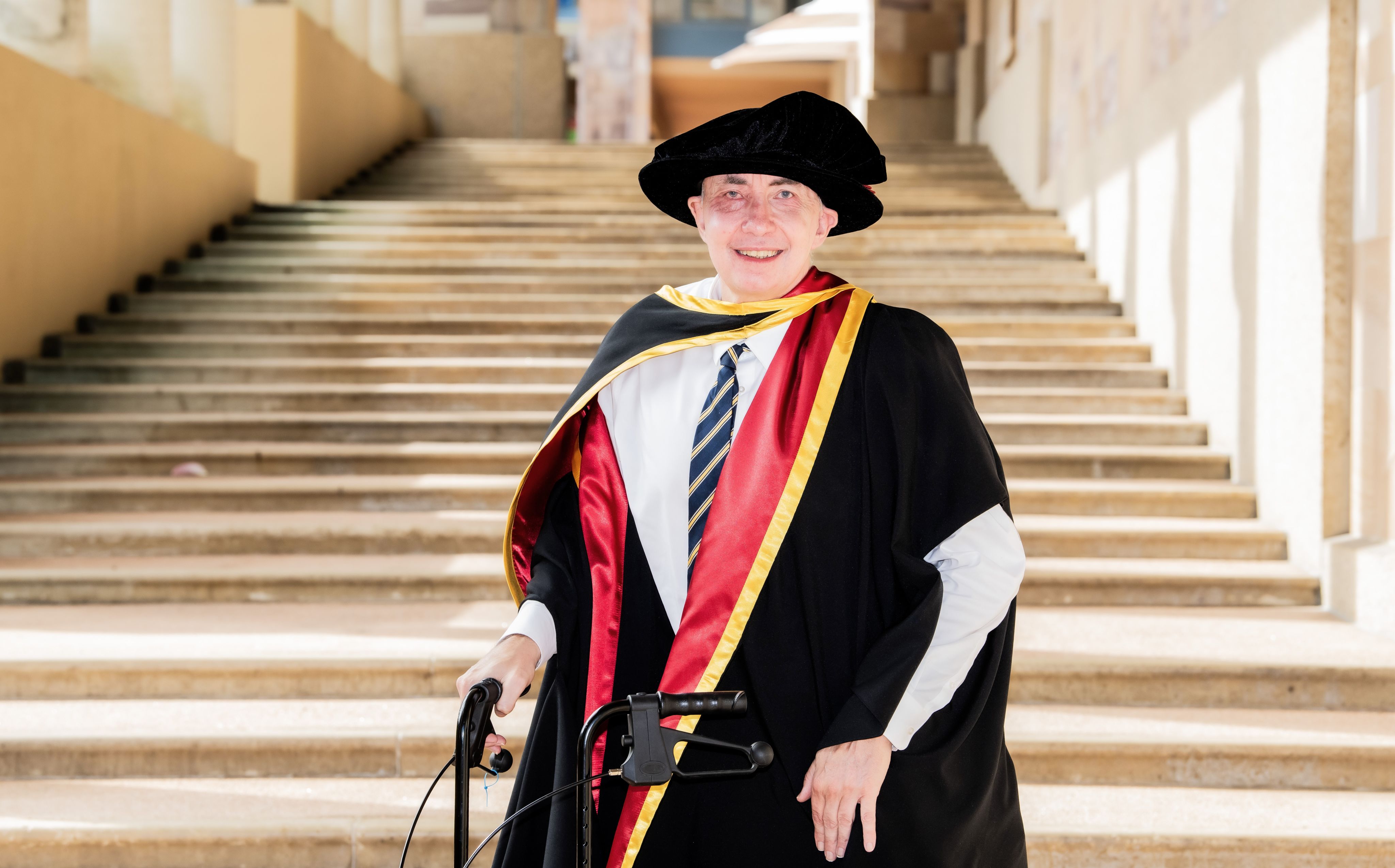
Forging paths
Andrew is familiar with adversity, though he didn’t realise it as a child. He was born 10 weeks premature resulting in lifelong cerebral palsy with doctors telling his parents he would never walk. One of his earliest memories is watching a man in a bowler hat enter his mum’s shop to tell her Andrew had to attend special school.
“I was in preschool but I could read by the time I was three. I couldn’t walk until I was five,” Andrew says.
“My mum insisted I go to the mainstream school around the corner, so I did.
“I would take a donkey on wheels that I pushed along, while other kids tried to hang for a ride. It helped me grow strong, and I’ve stayed fit and strong.”
During lunch breaks, his first-grade teacher Mrs Spencely taught him to walk without his imaginatively named “Donkey”. He continued to walk unaided until he was 35.
Andrew’s school nurtured his passion for reading, and he wrote his first novel at nine. He went on to gain a Bachelor of Arts in Criminology and English in Melbourne after his family emigrated to Australia.
Championing diversity
Andrew spent time in both countries as an adult but ultimately decided Australia felt like home. Eager to plant roots and put his degree to work, he moved near family on the Fraser Coast. A job fair propelled his next career move, but not in the way he expected.
Dressed in a suit and tie, and holding a CV with a degree and work experience, Andrew was judged for his disability.
“A woman with a severe perm said, ‘I’ll look at your CV, but there’s no work here for someone like you’, and that hit me in the guts,” he says.
“I almost returned to the UK. But the interaction had me consider how much more difficult things must be for others who hadn’t been given the opportunities I had.”
Andrew decided his next career move would be something he had spent most of his life avoiding — working in the disability sector where his own disability would be seen. It led to 11 years in disability employment support, helping people into the workforce across the Fraser Coast and Whitsundays.
“If we found a person a job where their disability didn’t come into play, then they weren’t considered disabled,” he says.
“It was difficult for employers to tell me a person with a disability couldn’t work around Airlie or on Hamilton Island, because I was doing just that.”

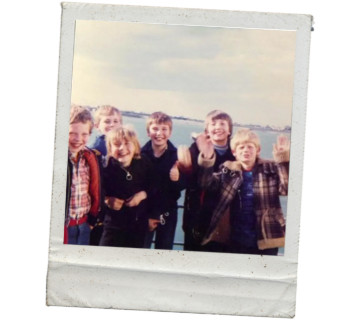
Andrew with his friends as a boy.
Andrew with his friends as a boy.
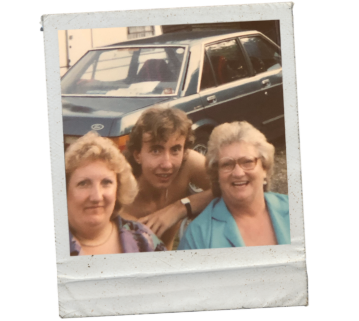
Andrew with his mum and sister in 1991.
Andrew with his mum and sister in 1991.
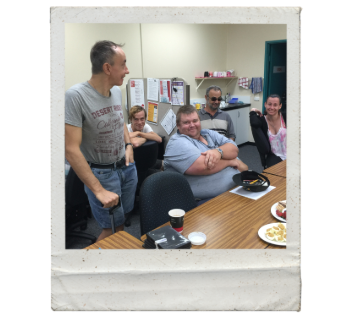
Andrew working at TAFE.
Andrew working at TAFE.
Forging paths
Andrew is familiar with adversity, though he didn’t realise it as a child. He was born 10 weeks premature resulting in lifelong cerebral palsy with doctors telling his parents he would never walk. One of his earliest memories is watching a man in a bowler hat enter his mum’s shop to tell her Andrew had to attend special school.
“I was in preschool but I could read by the time I was three. I couldn’t walk until I was five,” Andrew says.
“My mum insisted I go to the mainstream school around the corner, so I did.
“I would take a donkey on wheels that I pushed along, while other kids tried to hang for a ride. It helped me grow strong, and I’ve stayed fit and strong.”

Andrew with his friends as a boy.
Andrew with his friends as a boy.
During lunch breaks, his first-grade teacher Mrs Spencely taught him to walk without his imaginatively named “Donkey”. He continued to walk unaided until he was 35.
Andrew’s school nurtured his passion for reading, and he wrote his first novel at nine. He went on to gain a Bachelor of Arts in Criminology and English in Melbourne after his family emigrated to Australia.
Andrew with his mum and sister in 1991.
Andrew with his mum and sister in 1991.
Championing diversity
Andrew spent time in both countries as an adult but ultimately decided Australia felt like home. Eager to plant roots and put his degree to work, he moved near family on the Fraser Coast. A job fair propelled his next career move, but not in the way he expected.
Dressed in a suit and tie, and holding a CV with a degree and work experience, Andrew was judged for his disability.
“A woman with a severe perm said, ‘I’ll look at your CV, but there’s no work here for someone like you’, and that hit me in the guts,” he says.
“I almost returned to the UK. But the interaction had me consider how much more difficult things must be for others who hadn’t been given the opportunities I had.”
Andrew decided his next career move would be something he had spent most of his life avoiding — working in the disability sector where his own disability would be seen. It led to 11 years in disability employment support, helping people into the workforce across the Fraser Coast and Whitsundays.
“If we found a person a job where their disability didn’t come into play, then they weren’t considered disabled,” he says.
“It was difficult for employers to tell me a person with a disability couldn’t work around Airlie or on Hamilton Island, because I was doing just that.”
Andrew working at TAFE.
Andrew working at TAFE.
Andrew transitioned into the education sector in 2006, working at TAFEs where he tutored people of all backgrounds in literacy, numeracy, and work preparedness. He assisted people with disabilities, English language learners and early school leavers to gain qualifications and overcome barriers to employment.
His dedication to helping people of diverse backgrounds earned him the 2025 Student Experience Gold Coast Excellence in Championing Diversity award. The gala awards night brings the Gold Coast education community together each year to honour students’ achievements.
“I got up on stage and said, as of 24 hours ago, I am Dr Andrew Harris. And the table of Bondies erupted,” he says.
“It was a marvellous feeling.”
He left the crowd with some words of advice.
“I’d like to say to anybody who is enduring their own long journey, no matter what that may be, never give up, never give up, never give up.”
His PhD was another long journey involving years of planning and research, as well as health battles including a kidney disease diagnosis, a year spent on dialysis and a kidney transplant.
“My supervisors were extremely supportive throughout the ordeal, and continue to be,” he says.
“Incidentally, I had a renal check-up recently, and the transplanted kidney is at over 90 percent functionality.”
Assistant Professor Brotto says Andrew is an excellent example of resilience.
"While he really struggled with his health for quite a while, he never gave up, and that is truly admirable," she says.
As his successes sink in, Andrew is getting used to a quieter period with less deadlines. His writing supervisor, Associate Professor Graham, is supporting him in pitching his book to publishers and he’s been brainstorming opportunities for a film adaptation with his third supervisor, Associate Dean of Research Dr Damian Cox.
“I’m not sure what’s going to come next, but I know it’s going to be great,” he says.
Published on Wednesday, 7 January, 2025.


Dr Caroline Graham
Dr Gaelle Brotto
Prof Damian Cox
Original thinking direct to your inbox

Stories from Bond